
Cobb County Court Records After Arrest
After arrest and booking at the Cobb County Adult Detention Center, the jail roster reflects custody, booking charges, and bond amounts. Those entries are not the final court record. Prosecutors review the facts, decide what to file, and the case then appears in the court system that handles that charge type. Felony prosecution belongs to the Cobb Judicial Circuit District Attorney's Office, while misdemeanor and traffic matters are handled through the State Court and Solicitor General structure identified on the Cobb courts overview.
The pathway is arrest, booking, first appearance, prosecutor review, charging document, court case, then disposition. The Cobb County jail inmate records side answers custody and booking questions. The court record answers whether the prosecutor filed the same charge, amended it, dismissed it, reduced it, sent it to a grand jury, or resolved it by plea, trial, diversion, nolle prosequi, or other disposition. Booking photos follow a separate records-law route, so the mugshot topic belongs with Cobb County jail roster mugshots.
Search Cobb County Court Records
Cobb State Court is the clearest public portal for misdemeanor and traffic cases. The State Court Court Connect page links to the official State Court Records Search. The user guide says State Court data refreshes nightly, so a case-management update may not show until the next day. It covers State Court civil cases filed from March 17, 1997 forward and traffic or misdemeanor cases filed from April 26, 1999 forward.
- Search the sheriff roster first if the question is current custody, SOID, booking status, charges, or bond amounts.
- Use Cobb State Court Records Search for misdemeanor and traffic cases by name, case number, citation number, tag number, DOB year, or filing dates.
- Check the Superior Court Clerk records-search page and WebCaseManagement path for felony criminal cases.
- Use Magistrate Court resources for warrant and first-appearance context when the case is still at that stage.
- Contact the proper clerk or records custodian when a record is older, restricted, sealed, active, or missing from the public portal.
The Cobb State Court Records Search portal is the subject-matched court lookup source for misdemeanor and traffic records after a jail arrest.
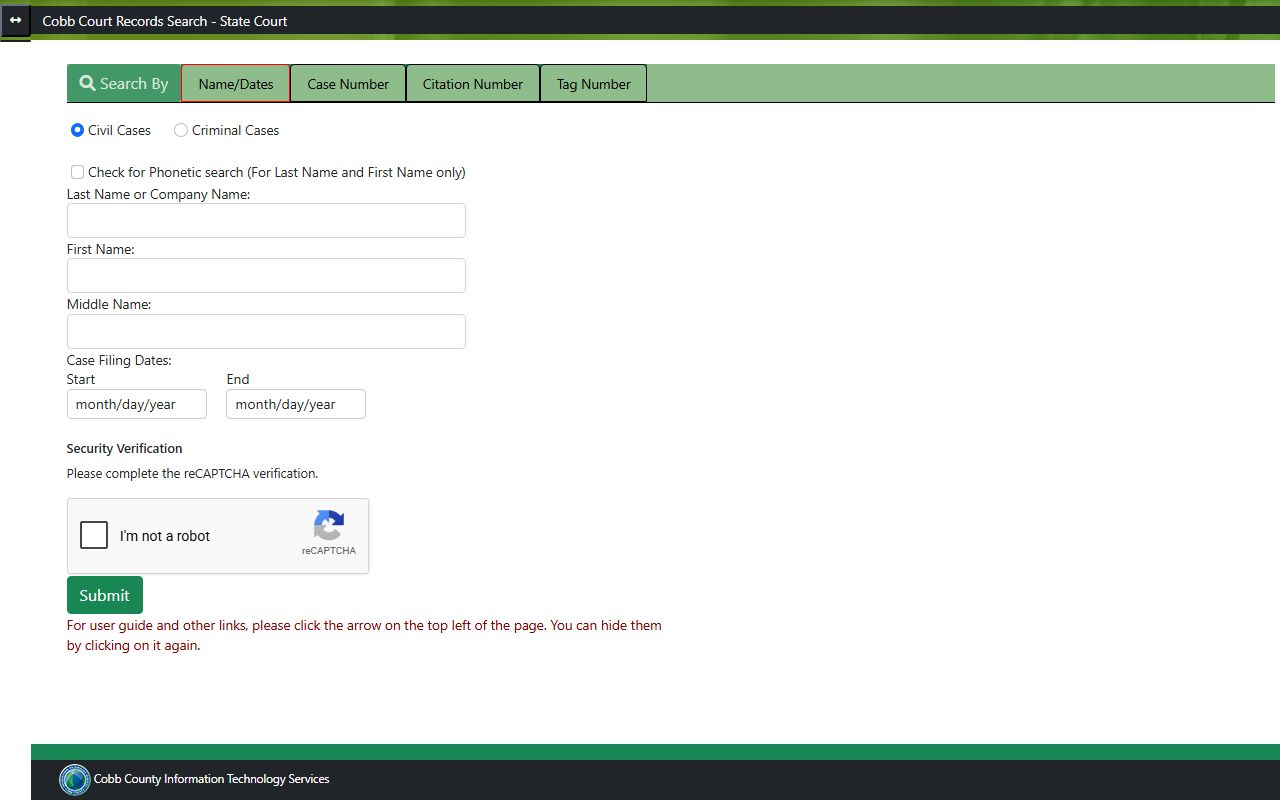
The portal has a reCAPTCHA requirement, which explains why manual searching may work even when automated inspection does not.
Cobb Court Search Fields
The State Court search has several paths. A broad name search can hit the 5,000-result cap, so narrower fields are useful. DOB year appears for criminal searches and can help separate people with the same name without exposing a full date of birth. The phonetic checkbox applies to first and last names only.
| Field Label | Type | Required | Notes |
|---|---|---|---|
| Search By | Tabs | Path choice | Name/Dates, Case Number, Citation Number, or Tag Number. |
| Civil Cases / Criminal Cases | Radio | One selected | Civil is default; DOB year appears for criminal cases. |
| Phonetic search | Checkbox | No | For last name and first name only. |
| Last, first, middle name | Text | Not specified | Name/Dates tab. |
| Date of Birth Year | Date/text | No | User guide says enter all four digits. |
| Case Filing Dates | Date range | No | Useful for narrowing after a jail arrest. |
| Case Number | Text | No | Example format shown in the guide: 24-A-12345. |
| reCAPTCHA | Verification | Yes | Must be completed before submitting the search. |
State Court results can be filtered, grouped, expanded, and opened through Case Details. A Documents button may open available documents in a new tab. Felony records may require the Superior Court Clerk route instead of State Court because the DA prosecutes felony criminal cases in the Superior Court framework.
Cobb County Charging Records
The charging document is the bridge between arrest and court records. It is where the accusation shifts from the jail booking entry to a filed court case. Georgia and Cobb sources support the general path, but the precise document used depends on charge level and prosecutor action. A complaint, accusation or information-style filing, and indictment have different roles, and the public case record should be checked for the actual filing.
| Document Type | Who Uses It | What It Means After Arrest |
|---|---|---|
| Complaint | Officer, warrant process, or prosecutor route | Starts or supports a lower-court criminal matter and may appear around warrant or first-appearance activity. |
| Accusation / Information | Prosecutor | Formal prosecutor filing often used to move a charge into court without a grand-jury indictment. |
| Indictment | Grand jury after prosecutor presentation | Formal felony charging document for serious cases presented by the District Attorney. |
The Cobb DA page says the office represents the State of Georgia in felony criminal cases, including investigation and preparation, grand jury presentations, trials, and appeals. That makes the DA a key office for felony prosecution records, but the public docket and filed instruments are generally clerk records rather than a jail roster function.
Cobb County Charge Status
A charge can change several times after a jail arrest. The jail may list a booking charge and bond amount, while the prosecutor may file a different formal charge or decline some counts. The court record can then show amendments, reductions, dismissals, plea, trial, sentence, diversion, nolle prosequi, or final disposition. Nolle prosequi means the prosecutor chose not to pursue that charge.
| Status | What It Means |
|---|---|
| Pending | The case or charge is still open and has not reached final disposition. |
| Amended | The filed charge was changed, often by wording, code section, or count detail. |
| Reduced | The prosecutor or court action lowered the charge level or replaced it with a lesser charge. |
| Dismissed | The charge was terminated by court or prosecutor action. |
| Nolle Prosequi | The prosecutor decided not to pursue the charge. |
| Disposition | The current or final outcome, such as plea, conviction, dismissal, diversion, or sentence. |
Note: Court portals and jail records refresh on different schedules, so urgent court-date questions should be verified with the correct clerk.
Bond After Cobb County Arrest
Bond is part of the arrest-to-court path because release may occur before the formal case is complete. The Cobb Sheriff bonding page cites O.C.G.A. 17-6-15 for sheriff bond guidelines and lists Bonding Administration as the public process point. The page also warns that multiple bonds may be required depending on the charges and lists a non-refundable fee per bond instrument.
| Bond Type | Cobb Sheriff Detail |
|---|---|
| Cash bond | Full amount in cash; returned by the court to the surety when appearance requirements are met. |
| Online cash bond | Available for bondable offenses through cashbondonline.com, with maximum online cash amount of $2,500 including surcharges and fees. |
| Driver's license collateral | Valid Georgia license may be used for certain misdemeanor charges except DUI when custody and amount limits are met. |
| Property bond | May use qualifying Georgia or Cobb County property with required documents and owner appearances. |
| Professional bond | Company must be registered and authorized by the Cobb Sheriff; Georgia law permits up to 15 percent or a minimum of $50 per charge. |
| Pretrial release | Pretrial may review eligible defendants and recommend release, bond reduction, or supervised conditions. |
A person can still remain in custody despite a listed bond if there is a no-bond charge, another agency hold, a probation or parole hold, an ICE detainer, an unresolved warrant, or a court condition that blocks release. First appearance timing is governed by Uniform Superior Court Rule 26.1, which requires appearance before a judicial officer within stated time frames unless bond was made first.
Cobb County Warrants and Arrest
Cobb County did not have a broad public active-warrant search form in the official pages reviewed. The Magistrate Warrant Division provides contact access at 32 Waddell Street in Marietta, phone (770) 528-8900, Monday through Friday from 8:00 AM to 5:00 PM. The Warrant Inquiry page is public-facing but contact-only for general users, while online attorney inquiry is restricted to State Bar of Georgia members.
The Cobb Sheriff Most Wanted page is not a complete warrant database. It shows selected wanted-person entries and warns users not to apprehend listed subjects. Bond calendar PDFs may show warrant numbers, police numbers, defendant names, charges, SOID, judge, and hearing location, but they are court calendar records, not a public warrant search engine.
Cobb Charges Versus Convictions
Being arrested or charged in Cobb County is not the same as being convicted. A charge is an accusation or filed count. A conviction follows a guilty plea, jury verdict, bench finding, or other final judgment that creates a conviction record. This distinction matters for records after a jail arrest because a roster row may still show a booking charge after the court case has moved in a different direction.
| Issue | Charge | Conviction |
|---|---|---|
| Stage | Allegation at booking or prosecutor filing. | Final court result after plea, verdict, or judgment. |
| Proof | Based on arrest, warrant, accusation, indictment, or probable cause. | Requires a court outcome that accepts or finds guilt. |
| Record source | Jail roster, warrant records, prosecutor filings, and court docket. | Court disposition, sentencing entry, and criminal-history records. |
| Can change? | Yes. Charges may be amended, reduced, dismissed, or nolle prossed. | Can be appealed, corrected, or restricted only through legal processes. |
Restricted Cobb Court Records
Georgia open-records law broadly favors access, but court and prosecution records can be limited. O.C.G.A. 50-18-70 states the Open Records Act policy, while O.C.G.A. 50-18-72 lists exemptions, including limits tied to law-enforcement and prosecution records. Juvenile matters, sealed records, restricted records, active investigations, and records barred by court order may not appear in a public portal.
| Issue | Sealed | Record Restricted |
|---|---|---|
| Public access | Hidden from ordinary public view by court order or law. | Limited for non-criminal-justice purposes under Georgia record-restriction law. |
| Georgia route | Depends on the court record and order. | O.C.G.A. 35-3-37 governs eligible criminal-history record restriction. |
| Cobb DA role | May be involved in felony case cleanup or court motions. | DA Record Restriction and Second Chance Desk pages explain local felony follow-up options. |
The Cobb DA Record Restriction page says felony arrests after July 1, 2013 in Cobb County can be submitted by email with a completed form and government ID photocopy. Older felony inquiries use a separate DA records address. Pretrial Diversion is also important because successful completion can result in dismissal or nolle prosequi and record restriction.
Cobb County Prosecutor Records
The current Cobb Judicial Circuit District Attorney is Sonya F. Allen. The DA's office represents the State of Georgia in felony criminal cases in Cobb County, including investigation, preparation, grand jury presentations, courtroom proceedings, trials, and appeals. DA records are not the same as the jail roster or every court filing, but they can matter when a felony charge is pending, amended, dismissed, or restricted.
Cobb Judicial Circuit District Attorney's Office
70 Haynes Street
Marietta, GA 30090
(770) 528-3080
Monday-Friday, 8:00 AM-5:00 PM
DA Open Records
General email: cobbdistrictattorney@cobbcounty.gov
Open records: CobbDAOpenRecords@cobbcounty.gov
Fax: (770) 528-3030
Use for prosecutor records rather than jail custody records.
Important: Public court lookup is not a consumer report and should not be used for FCRA-covered screening.